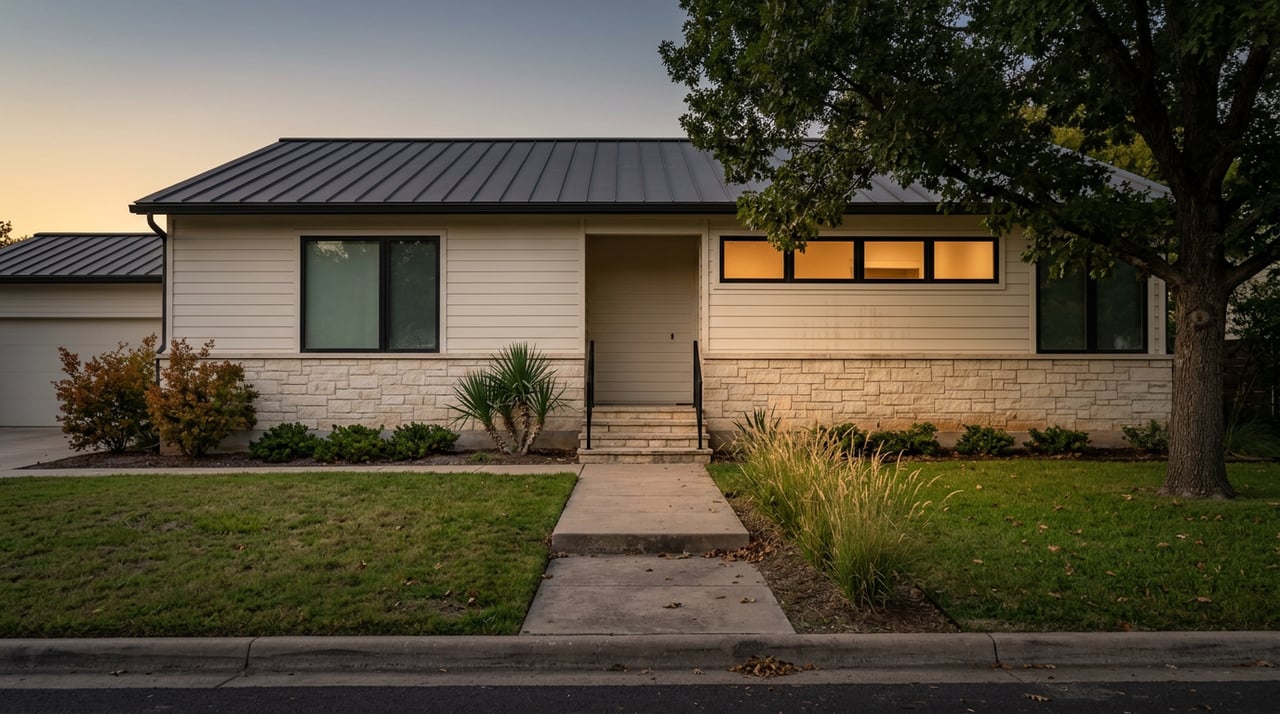
Two houses go on the market in Fountain the same week. Both list at $419,000. Both are three-bedroom, roughly 1,900 square feet. One sits on a street platted in the early 2000s. The other is a new build a mile east, inside a metro district that was formed to finance the roads, sewer, and parks around it. On paper, they are the same house at the same price. On the closing statement, one carries a property tax bill the other does not, and it can run several thousand dollars a year for the next three decades.
That gap is the story the list price does not tell you. Fountain's affordability headline in 2026 is real, but it is not uniform across the map. The mill levy attached to a parcel decides whether a $419,000 house behaves like a $419,000 house or something meaningfully more expensive to hold.
The Base Number Almost Nobody Contests
Start with the city itself. The City of Fountain raised the property tax in 2022 for the first time in 32 years. The last time Fountain raised property taxes was in 1990. Fountain's current Mil Levy is 16.339 which was passed by the City of Fountain voters through a ballot initiative with 54.67% voting yes. For a city sitting on the south edge of a metro that added tens of thousands of residents in the last decade, 16.339 mills is a light touch, and the effective picture bears that out. Fountain's median effective property tax rate of 0.39% is lower than the Colorado state median of 0.50% and lower than the national median of 1.02%.
That's the number quoted in most affordability comparisons. It is also the number most likely to mislead a buyer who is choosing between a resale on an established block and a new build in the next phase of a subdivision. The word doing the heavy lifting there is median.
Where The Extra Mills Come From
A metro district is a taxing entity created inside a development to pay for the infrastructure that used to be baked into the price of the lot. Metro districts are commonly established by developers to create the necessary infrastructure to support turning vacant land into a new subdivision. This includes the development of streets, water and sewer lines, irrigation systems, parks, community pools, etc. If all goes according to plan the constructions of homes and businesses will follow once the infrastructure is in place. The trade is that in a metro district, those costs are generally paid by proceeds of the bonds issued by the district over the term of the bonds, usually 30 years, in the form of property taxes, rather than being added to the initial cost of the home. The bonds (debt) are paid from the proceeds of the debt service mill levy, which is approved in conjunction with the formation of the district.
Fountain's largest active example is Mesa Ridge, the reworked subdivision on the east side of town. A subdivision in eastern Fountain known as Mesa Ridge has been reimagined this year to feature more multifamily housing and a different site for businesses. Developers are expecting to build about 1,800 homes and 21 acres of commercial development south of Mesa Ridge Parkway and west of Marksheffel Road inside the existing Fountain city limits, plans show. The Fountain City Council approved both a new plan for the property in March and new metro districts needed to finance the infrastructure across 471 acres in September.
The financing structure is where the buyer's math changes. In September, the city approved three new metro districts that can issue up to $65 million in debt to finance the subdivision, city documents said. The first bonds totaling $5.1 million to fund the project could be issued in December 2026. Under the approved metro district plan, up to 45 mills could be added to property tax bills of new residents.
Forty-five mills is not a rounding error. Applied to a Colorado home valued around $400,000, with an assessed value near 7% of market, the additional annual bill from the metro district alone lands in a range that materially changes what a buyer can afford in principal and interest. To put a real-world number on the pattern, a Denver-market analysis found that a home in a metro district may pay $2,000–$3,000 more annually than one in a standard district due to added mills for infrastructure, bonds, and services. Fountain's newest subdivisions sit at the upper end of that logic because the districts are early in their build-out and the debt is fresh.
Here is the structural piece worth remembering:
| Component | Applies to | Duration |
|---|---|---|
| City of Fountain base levy (16.339) | All Fountain parcels | Ongoing |
| El Paso County + school district levies | All Fountain parcels | Ongoing |
| Metro district debt service mill (up to 45) | Parcels inside a metro district | Life of the bonds, typically 30 years |
| HOA dues | Varies by community | Ongoing |
The bottom row matters more than most buyers expect. Do not assume that if a property is located in a metro district that you will not also have additional HOA fees. Some properties located within metro districts also belong to a home owners association (HOA) and may have additional assessment fees, status letter fees, record change fees, etc.
Why 2026 Is The Inflection Year
Metro districts are only useful to a developer if the city can actually deliver water to the taps. Fountain paused new development in past cycles because it could not. That constraint just loosened.
In March 2026, Colorado Public Radio reported that Fountain, along with Security and Widefield water districts, is part of an existing permanent well water lease with Venetucci Farm. A new 50-year agreement allows Fountain to take part of Security's allocation from the historic farm's wellfield in southern El Paso County. Security initiated the negotiations because it didn't need the full amount of water it was entitled to. The volumes are specific and consequential. Fountain will get about 521 acre-feet of water a year, up from the current allocation of 135 acre-feet. An acre-foot could serve about 1-5 households, depending on usage efficiency. The city staff estimates this new supply could support about 1,000 new home taps.
The cost side is modest at the city level. The volume of water transferred each year will increase between 2026 and 2030 with costs rising accordingly. The additional annual expense to Fountain is estimated to eventually reach about $190,000. Fountain's current annual water supply costs are approximately $3.3 million. Water resources manager Taylor Murphy framed the impact plainly in a council presentation, saying "this water really helps us increase our system capacity by roughly 20% with the amount of taps that we are bringing online to enable new growth and development". City leaders say it will not be a sudden change and 50% of the water will be allocated for residential use, 30% for commercial use and 20% for other city projects.
Line up the timing. The Mesa Ridge metro districts are positioned to issue their first bonds in December 2026. The water needed to bring taps online has just been secured. What that means for a buyer looking at Fountain in the second half of 2026 is that the pipeline of homes offered inside metro districts is about to grow, not shrink, and those homes will carry the higher effective tax load for the duration of the bonds.
How To Read A Fountain Listing's Tax Line
The transaction-level friction shows up between the offer and the closing table, usually in the title work. A few steps will keep you from being surprised.
- Pull the tax certificate before you write the offer, not after. Taxing information for metro districts is included in the tax certificate available at the time of purchase. The certificate lists every mill levy stacked on that parcel, not just the city and county.
- Ask for the district's service plan. Frequently, the Service Plan required by the county/municipality sets limitations on mill levies, term of bonds, limiting boundary changes, and restricting eminent domain powers. A cap on the debt service mill is written into that document.
- Check build-out. Current Level of Construction Compared to Planned "Build-out." This information is available from the metro district. Analyzing how near completion the development is will help estimate the tax burden per home. If the home lots are not selling and not occupied by homeowners paying taxes, less build-out means that the presently developed properties are responsible for more than their apportioned amount. Early-phase buyers in a slow-selling district can end up carrying a disproportionate share of the debt until the district fills in.
- Look at debt-to-assessed value. Debt/Assessed Value Ratio: This ratio shows the metro tax district's ability to support debt based on the value of real property in the district. A high ratio early in a district's life is not automatically a problem, but it is a question worth answering.
- Underwrite the monthly, not the sticker. If the metro district adds thousands of dollars a year, your lender will size the escrow accordingly, and your qualifying ratios move.
The Established-Vs-New Tradeoff
Fountain's older inventory sits outside these newer districts. Communities like Talon Ridge and Cumberland Green were referenced by one local search source as first-time-buyer stock, located close to an elementary school, Fort Carson, and Peterson AFB, and they generally predate the metro district financing wave now shaping the east side. That is not a value judgment. New construction in a metro district often comes with amenities that a 2005 build does not, and the finish level is different. It is a tradeoff a buyer should price consciously.
The state of the broader market gives you room to be picky. In July 2026, Redfin reported the Fountain median sale price around $400,000 and typical days on market at 63. That is not a market where buyers are stripping contingencies. It is a market where the buyer who reads the tax certificate carefully has leverage the buyer who does not is giving away.
One more piece of context. The city's own planning work is moving alongside the growth. Fountain's 2025–2027 strategic plan sets targets around completing a review of the commercial/industrial development processes in Fountain by July 2026, with a presentation to City Council on key findings and recommendations, and a public information campaign focused on Fountain's option to join the Pikes Peak Rural Transportation Authority by August 2026. Both change the shape of the tax and service picture over the horizon a buyer is holding the home.
Quick Questions Buyers Ask
Does every new build in Fountain come with a metro district mill? No. The presence of a district depends on how the subdivision was financed. The tax certificate for the specific parcel is the fastest way to confirm.
If the district hits its debt service cap, can the mill go higher? The cap is written into the service plan. Reading the actual document, or having your agent do it, is how you verify what the ceiling actually is on that parcel.
Is metro district tax deductible the way HOA dues are not? That is a question for a tax professional applied to your specific return. What is true is that the two line items behave differently on a tax form and that the answer depends on your situation.
Will the Venetucci water lease change what I pay as an existing homeowner? The additional cost to the city is modest against its overall water budget, and the water is targeted at supporting new taps. It is more likely to change what and where gets built next than to shift an existing bill in the short term.
If you are weighing a Fountain purchase in the next few months and want a plain reading of a specific parcel's mill stack before you write an offer, that is the kind of pre-offer work DogHouse Real Estate Group does as a matter of course. Schedule a free consultation and we will pull the tax certificate, read the service plan, and put the monthly number in front of you before the emotional part of the decision begins.